747s Fly Over Erie
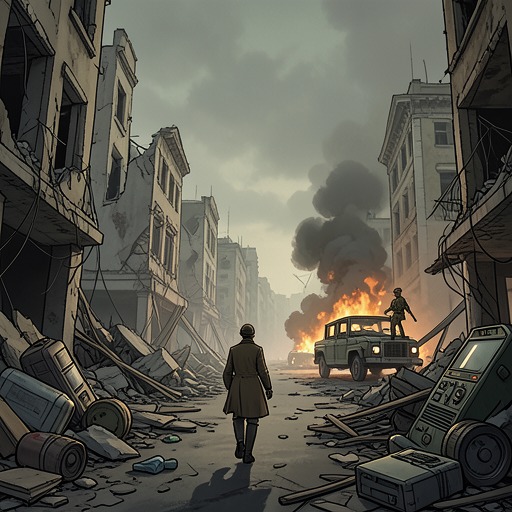
The Dog StarsThe overflight of two 747s over Erie breaks a silence that Hig has come to treat as the world’s condition. He hears the jets while working in the garden, then runs to the Beast and calls them repeatedly on the radio. They never answer. Their later returns turn a startling sight into a pattern, but not into contact: the aircraft offer evidence of a world still moving beyond his horizon, without telling him who is aboard or whether anyone can hear him.
The First Overflight
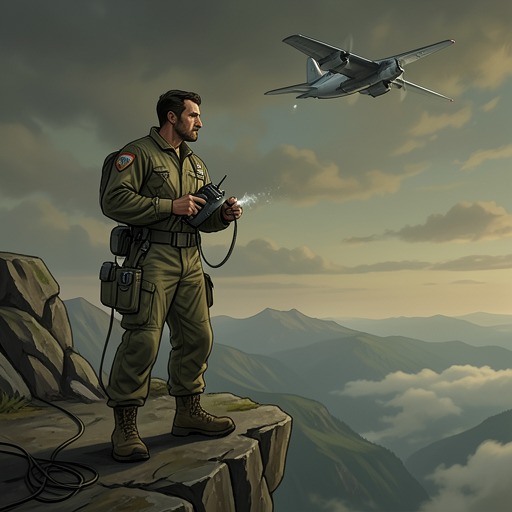
On or about July 4, Hig is killing potato bugs in the garden. Cima is spending the day with the families, where she is administering a vitamin D infusion for the children. On the porch of Hig’s house, Bangley and Pops are playing chess; Bangley’s cane rests against the rail, and their game has become part of the household’s ordinary rhythm. Then Hig hears a familiar sound. He has heard it so often that he does not look up immediately. Only after realizing how long it has been does he turn toward the sky and see two parallel vapor trails, one following the other, with the sound of engines receding.
Hig runs to the Beast, switches on the radio, and searches frequencies with a Narco scanner. The numbers cycle through static until a voice breaks through. He hears conversation and laughter in Arabic, and gathers that the aircraft are heading west at thirty thousand feet, probably toward California. The voice is not an answer to him: Hig calls out to the two 747s, identifying Erie and repeating his appeal, but receives no reply. From that altitude, he reasons, their airport would be difficult to distinguish from the surrounding decaying infrastructure. The jets disappear, leaving him stunned and uncertain whether their passage is good news or bad.
Recurrence Without Contact
A week later, at approximately the same time, two more aircraft pass. Another pair follows the next week. By the fourth week, Hig and the others have begun gathering on the porch in the afternoon, waiting for the sight as if it were a scheduled public occasion. That week, nothing comes. The small communal ritual makes the flights feel less like isolated sightings and more like a possible signal, but the missed appearance offers no explanation. In September, two more pass overhead. Hig calls again; they never answer.
The evidence accumulates in a peculiar form: aircraft, voices, direction of travel, and repeated passage, but no exchange. The jets demonstrate that pilots are flying across the region and that their transmissions can sometimes be heard. They do not establish where the planes began, who is on board, or whether their occupants know that anyone is calling from Erie. Hig’s repeated attempts therefore end in the same unresolved gap between hearing and being heard.
What the Flights Might Mean
The overflights matter because they make survival beyond Erie imaginable, not because they confirm it. Cima proposes that the people aboard may have immunity, or that immunity could belong to a race or clusters of people; she also suggests that an entire tribe might have been spared. Her explanation is a possibility, not information verified by the aircraft. The Arabic conversation supplies a clue to the world the planes traverse, while the unanswered calls prevent that clue from becoming a meeting or a reliable account of life elsewhere.
That uncertainty has particular force in a life shaped by losses that cannot be called back. Hig remembers the trout vanishing from the streams as water grew too warm, and the old seasonal measures becoming little more than nostalgia. He still goes into recovering forest to fish, carrying his Sage pack rod, but even the remaining carp are eventually gone. Against this history, the vapor trails are not proof that nature or society has recovered. They are a brief sign of motion above a damaged landscape, and a reminder that the future may contain people Hig cannot reach.
Narrative Significance
The event is presented through Hig’s practical response: he recognizes the sound, runs to the Beast, works the scanner, and calls until the aircraft are beyond reach. The sequence converts an ordinary afternoon—gardening, medical care among the families, and a porch chess game—into a moment of collective waiting. Later afternoons repeat that expectation, giving the flights a place in the group’s shared calendar without resolving their meaning.
The overflights thus change the scale of Hig’s isolation without ending it. Before the first pair appears, the airport and its nearby relationships form the limits of what he can directly know. Afterward, there is a larger world overhead, communicating at a distance in a language he recognizes but cannot turn into conversation. Each unanswered call confirms both that others may still be out there and that their presence alone cannot make them reachable.